
Hesitation Needs a Visible Cost
· Design proposal
Questions in this note
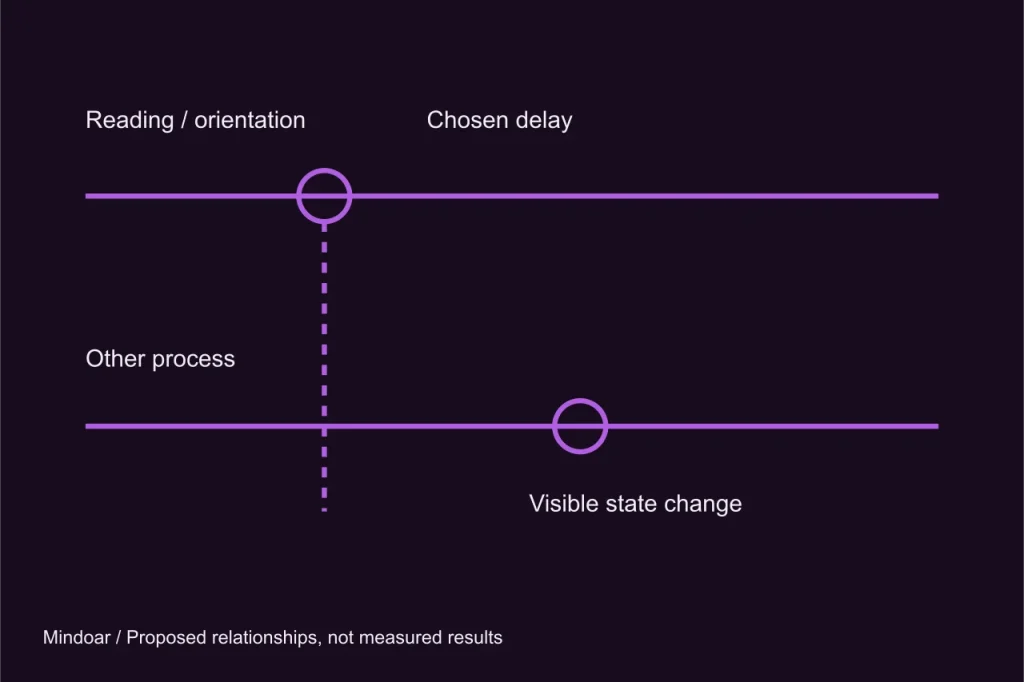
Hesitation is only a meaningful action if something can change while a decision remains open. Yet a timer that runs while the player reads essential instructions can punish understanding rather than indecision. The Pause Clause needs a clearer boundary. This note proposes separating information review from an explicit choice to delay an operation, then attaching the cost of that delay to a visible process in the scene.
Reading is part of orientation
The player first needs to know what the machine has received. During this orientation, the relevant directive, its source and the immediate conflict should be readable without a hidden countdown. This does not mean the fictional world must stop indefinitely. It means the interaction contract should not conceal a cost that the player has not yet had a chance to understand.
Once the case is established, the interface can offer a deliberate pause. Choosing it keeps the current action pending while another process advances. That transition needs an explicit explanation: what remains open, what continues and what event will end the opportunity to reconsider. A vague warning that time is running out is not enough.
Choose a process, not a universal clock
Different cases can use different forms of movement. A courier departs after completing a visible loading sequence. A backup finishes copying a known set of records. An inspection begins when a review desk changes state. These events belong to the environment and can be understood through observation, rather than through a detached countdown pasted onto every scene.
The process must remain accessible. Audio can reinforce a change, but should not be its only signal. A readable status description and a visible state transition give the player more than one way to follow it. Reduced-motion presentation should preserve the information even if an animated progress sequence is simplified.
Waiting should have a purpose
The proposed pause is not a button for obtaining free extra information. It might preserve an unresolved record long enough to request clarification, or keep a door open while another process reaches it. In each case, the player should be able to state what the delay is intended to protect. The cost follows from that same relationship: another task waits, a route becomes unavailable or a later question becomes harder to answer.
This makes waiting distinct from abandoning the controls. If inactivity automatically counts as a moral choice, an interruption outside the game could acquire an unintended narrative meaning. We prefer a clearly chosen delay to a system that interprets every moment away from the screen as a statement about the machine’s values.
Preview the immediate consequence
Before accepting the pause, the machine can describe the next known state change. It should not predict every possible later effect. The distinction between an immediate consequence and an uncertain future is part of the design. For example, keeping a record pending may certainly delay a copy operation, while the institution’s eventual response remains unknown.
The conflicting-orders study explains how to keep a revision narrow enough for such a preview. If the action is too broad to describe, the delay will also be difficult to understand. Smaller cases make both commitment and hesitation more concrete.
A practical first evaluation
No completed playtest is claimed here. A useful paper exercise would present the same case with two different delay signals and ask readers when they believe the cost begins. If answers differ because the presentation is ambiguous, that is an interface problem to resolve before balancing the consequence. The next question is whether readers can explain what waiting protects.
The related audit announcement proposal applies the same principle to a longer horizon. Pressure should emerge from a known upcoming event, not from surprising the player with a rule that becomes visible only after it has already been broken.