
Announce the Audit Before It Arrives
· Design proposal
Questions in this note
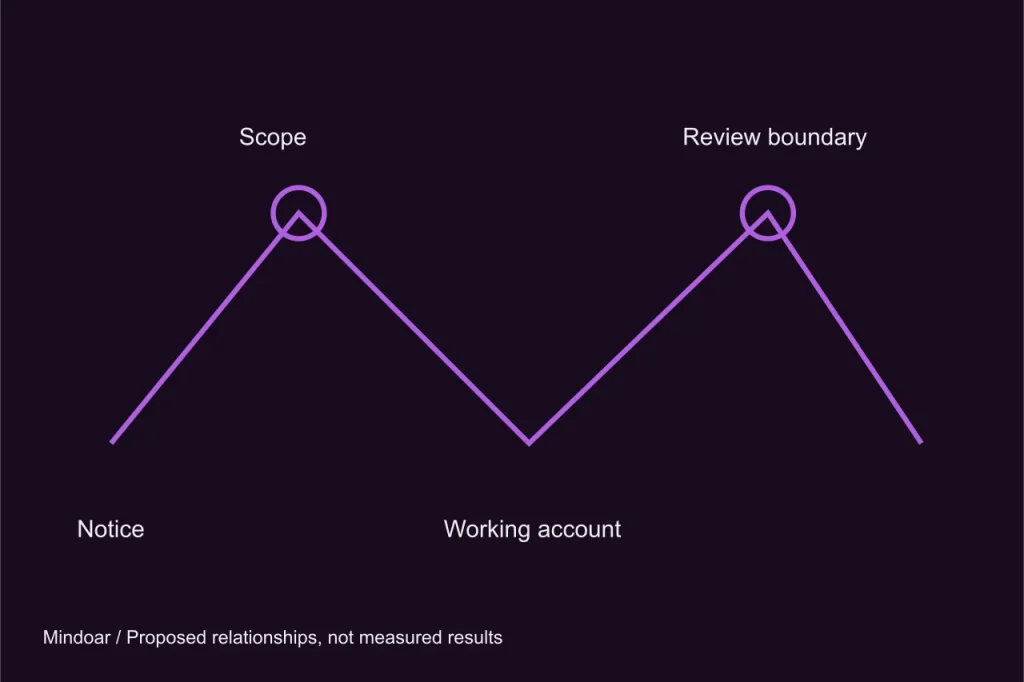
An inspection can create tension before it begins. In After the Audit, that tension comes from preparing a record that cannot preserve everything. The player needs enough notice to understand the task, but not a complete prediction of the review’s outcome. This note examines what an announcement should disclose and what can reasonably remain uncertain within the fictional institution.
Name the scope of review
The first announcement should identify the decision being examined. A general warning that the machine will be audited leaves too many possible interpretations. Is the review about a particular exception, all recent actions or the integrity of the memory system itself? Each scope would lead to a different selection of evidence. The player cannot make a meaningful preparation if that distinction remains hidden.
We propose a short review notice tied to a visible case reference and a small set of questions. The questions describe what the institution seeks to understand. They do not reveal the exact response that any combination of fragments will produce. This preserves room for interpretation without concealing the basic purpose of the exercise.
Explain the retention limit
The memory allowance also needs a comprehensible role in the fiction. A limit that appears only when the player has finished arranging an account would feel like an arbitrary puzzle restriction. The archive should show the available review capacity before selection begins, and keep that capacity visible while fragments are compared.
We want to avoid presenting capacity as a claim about real artificial intelligence or computer memory. This is a fictional constraint designed to focus a narrative choice. The visual language of cartridges and review slots gives it a physical form, but the site should not imply that the concept is an accurate technical model of consciousness or machine learning.
Separate notice from commitment
Receiving the notice should not submit the current account. Reading a question, moving a fragment and committing the record are distinct actions. The final boundary deserves its own clear control and a summary of the known omissions. A player should not discover that a routine navigation step has silently finalised the selection.
The memory-context note explains why the summary should describe relationships rather than merely count fragments. An account with more pieces can still omit the instruction that explains the central action. The review preview should make that known gap visible without pretending to judge the whole story.
Let reminders add context
Repeated warnings can become noise if they only restate that an audit is coming. A useful reminder should report an actual change: a review desk is ready, a transfer channel is closing or an additional question has been issued. If the scope changes, the interface must say so explicitly and provide a fair opportunity to reconsider the working account.
The scene should not manufacture pressure by accelerating reminders while the player reads. Timing belongs to the chosen interaction model. The hesitation study proposes an explicit transition between orientation and a deliberate delay; a similar distinction can help the archive avoid treating slow reading as a failure.
Keep the reviewer fallible
An announced scope does not mean the fictional reviewer is perfectly fair or omniscient. The institution may ask a narrow question that fails to capture the machine’s experience. That can be part of the story, provided the interface distinguishes institutional expectations from objective truth. The player should be able to understand what is being requested without being told that satisfying it settles every moral question.
This remains a design proposal. An early evaluation would ask readers to identify the review’s subject, the capacity limit and the final commitment action after seeing the notice once. Confusion about those basics should be corrected before adding more dramatic uncertainty. A strong announcement gives the player a stable starting point from which a difficult decision can develop.