
A Memory Is More Than an Event
· Design proposal
Questions in this note
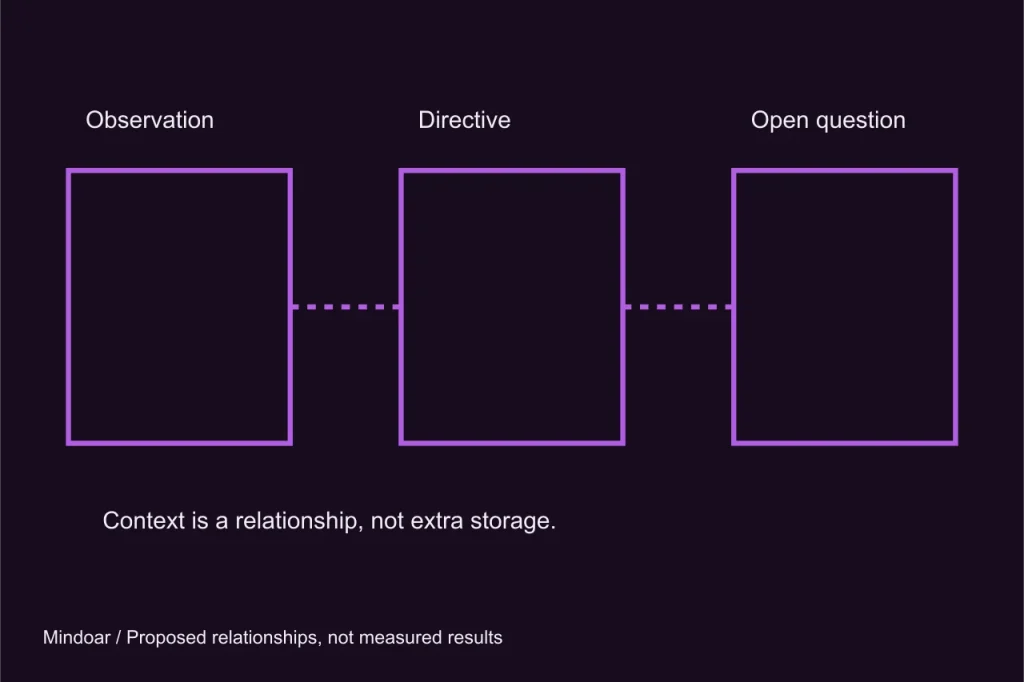
A recording of a door opening does not explain why the door was opened. That gap is central to After the Audit, where an awakened machine prepares a limited record of its decisions. If every memory token contains both an event and a complete explanation, choosing which token to keep becomes a simple inventory problem. We want the selection to involve relationships that the player can inspect and understand.
Three parts of a useful fragment
The proposed archive distinguishes an observation, an associated directive and an unresolved question. An observation might show a blocked service route. A directive might require that route to remain clear. The unresolved question might concern whether a temporary obstruction qualifies as a safety exception. These parts are related, but they are not interchangeable.
Separating them gives the player a reason to consider context. It also creates a responsibility for the interface: known dependencies must be visible before anything is removed. The machine should not knowingly hide a crucial connection merely so the story can reveal a surprise later. Uncertainty is more compelling when its boundaries are honest.
A working account is not a final record
We propose a provisional arrangement area where fragments can be moved without committing a deletion. The archive remains intact while the player compares possible accounts. A distinct review action then shows which questions the selected fragments answer and which remain open. Only an explicit commitment changes the retained record.
That separation is important for accessibility as well as narrative clarity. Reading a fragment should not accidentally consume it. Keyboard focus should move predictably through the working arrangement, and returning to an earlier selection should preserve the player’s place. The emotional weight belongs in a considered decision, not in a fragile drag-and-drop gesture.
Describe the missing relationship
A warning such as insufficient evidence is too vague to support useful revision. A more informative prompt would say that the selected record shows the action but does not include the instruction under which it occurred. This identifies a gap without dictating which fragment the player must choose. Another account might address the same question through a different observation.
The proposal should not promise that a complete-looking account will produce a favourable review. An institution can interpret evidence differently from the machine that assembled it. The immediate interface obligation is narrower: disclose what is present, disclose known gaps, and avoid presenting an uncertain interpretation as a guaranteed result.
Give storage a physical presence
The visual study uses cartridges, sockets and a review surface rather than floating abstract folders. Removing a cartridge leaves a visible space. A faint reconstruction above the selected device connects the record to a place, while the surrounding archive remains in view. This physical continuity should help the player remember which part of the account they are considering.
The objects must still remain readable at small screen sizes. Fine engravings and subtle colour differences cannot carry essential information by themselves. Shape, position and plain labels should reinforce the relationship. The concept art establishes atmosphere; the eventual interface would need separate tests for legibility and navigation.
Avoid a universal value score
Assigning every fragment a single importance number would make comparison easy, but it would also erase the point of the system. A short directive may explain more than a long recording in one case and be irrelevant in another. Value depends on the question being asked. We therefore propose showing the questions associated with a fragment instead of ranking memories globally.
The directive-conflict note provides an example of the sort of case this archive might later need to explain. The audit warning note considers how to introduce the review’s scope early enough for a player to make a meaningful selection. These are design proposals, not reports of a finished memory simulation or measured player behaviour.