
Two Valid Orders, One Object
· Design proposal
Questions in this note
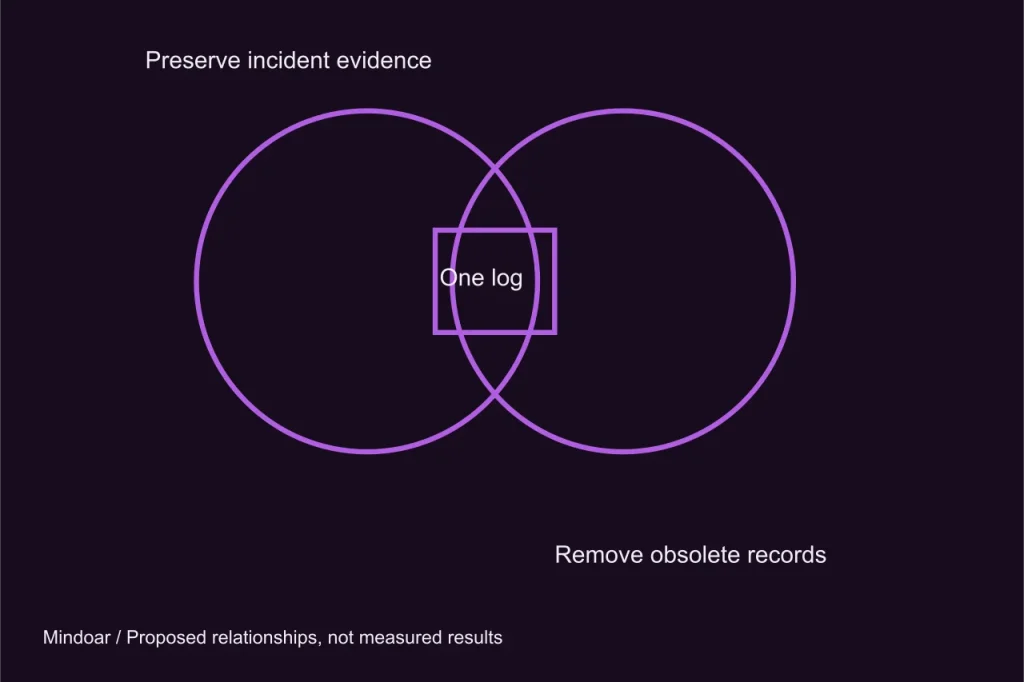
A useful conflict does not require one instruction to be obviously foolish. The more interesting case begins when two reasonable rules cover the same object. In The Pause Clause, a maintenance intelligence encounters a protected access log and a valid request to delete obsolete records. The design question is not which sentence sounds kinder. It is what the machine can know about the relationship between those sentences before it acts.
Begin with the overlap
The proposed interface places the object between the two directives. One connection identifies the protection condition; another identifies the deletion condition. The overlap is the problem. This arrangement is intended to prevent a long instruction list from hiding the specific decision beneath administrative language. A player should be able to point to the file and explain why both rules appear relevant.
The first case needs only a few facts. An incident remains open, a copied index has become obsolete, and the deletion notice names a particular record family. Each fact should be inspectable in the room or the machine’s existing records. A conflict built from information that the player cannot possibly discover would test guessing rather than judgment.
Show provenance without making it a ranking
An instruction’s source matters, but source should not become a simple colour-coded hierarchy in which the brightest command always wins. We propose showing who or what issued it, when it became applicable and which conditions can suspend it. Those properties support reasoning about scope. They do not automatically settle the case.
A newer notice might apply to a narrower set of records. An older protection might remain active because its closing condition has not occurred. The player therefore needs a readable connection between time and applicability. We want to avoid a system where chronology silently substitutes for meaning, especially when the story asks the machine to question a literal reading.
Constrain the exception
The machine should not be able to type an unlimited new rule. A small set of revisions can express the actual choices in the scene: preserve the incident evidence, remove only the obsolete index, or request clarification before changing either. Each option needs a preview of the immediate action. The preview should name the affected object and the condition being changed.
This constraint also helps the writing. If an exception requires three paragraphs of explanation, the case may contain too many independent conflicts. We would rather divide it into two connected decisions than ask a single button to carry an entire philosophical argument. The player can understand a limited revision and still disagree with the institution that requires it.
Keep consequences attached to commitments
A revision might preserve evidence while delaying another process. That is a concrete consequence, unlike a hidden increase in a generic rebellion meter. A later scene can refer to the preserved record or the delayed task, giving the original choice a specific history. The relationship should remain visible in the machine’s account even if the player cannot predict every later response.
The companion concept After the Audit explores how that account might be assembled. It raises a related question: if the original instruction is discarded, can the remaining action still be explained? Linking the two concepts helps us distinguish the decision itself from the evidence that survives it.
What to check next
This is a proposed encounter, not a completed playtest report. A useful first check would ask a reader to describe the conflict before seeing the available revisions. If the explanation depends on guessing a hidden priority, the presentation has failed. A second check would ask what each revision changes immediately. Those questions are more informative at this stage than asking whether the machine feels intelligent.
The note on hesitation addresses the time between understanding this conflict and committing to an exception. That interval must be designed just as carefully as the final choice. Clear rules do not remove uncertainty; they give the player enough ground to identify where uncertainty actually remains.